American Frontier Heritage PNG: A Practical Guide for Designers and Makers
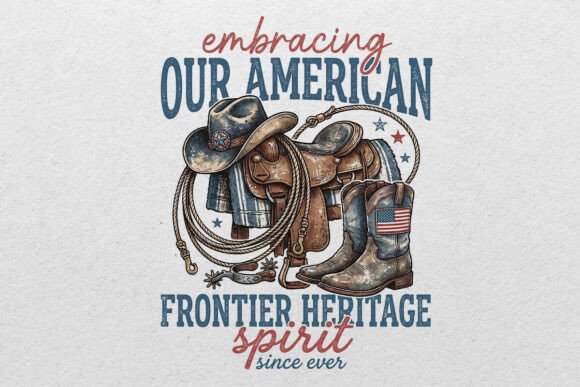
When sourcing digital graphics rooted in historical American iconography, the American Frontier Heritage PNG stands out for its thematic specificity and technical readiness. Unlike generic Western or rustic-themed clipart, this collection centers on visual motifs tied to 19th-century U.S. frontier life—think weathered wagon wheels, vintage typography evoking territorial maps, hand-drawn cattle brands, sepia-toned silhouettes of covered wagons, and stylized frontier town signage. What distinguishes it is not just subject matter, but execution: each design is delivered as a high-resolution, transparent-background PNG file at 4500 × 5400 pixels—large enough for print-on-demand apparel, wall art, or large-format vinyl decals without visible pixelation.
How It Differs from Broader Western or Americana Graphics
Many designers begin their search with broader terms like “Western PNG” or “Americana clipart,” only to find results ranging from cartoonish cowboy illustrations to modern minimalist interpretations. The American Frontier Heritage PNG occupies a narrower, more intentional space. It avoids contemporary stylization (e.g., neon-lit saloon signs or vectorized cacti with gradients) and instead leans into historically grounded aesthetics—subtle texture overlays, ink-line fidelity, and muted earth-tone palettes that suggest aged paper or engraved metal. This makes it especially useful when authenticity matters: for museum gift shop merch, educational materials about westward expansion, or branding for heritage-focused small businesses like craft distilleries or regional history podcasts.
In contrast, general-purpose Western bundles often prioritize quantity over cohesion—hundreds of isolated elements with inconsistent line weights, scaling, or color depth. The American Frontier Heritage PNG trades breadth for unity: every included graphic shares a consistent visual language and resolution standard, reducing time spent adjusting contrast, resizing, or masking backgrounds.
Practical Use Cases and Real-World Fit
The American Frontier Heritage PNG is designed for immediate integration—not just into creative software, but into real production workflows. Because files are delivered as transparent-background PNGs, they import cleanly into Cricut Design Space, Silhouette Studio, Adobe Illustrator, Canva, and even Microsoft PowerPoint. No clipping masks or background removal needed. That saves time for makers who cut vinyl for barn doors, apply heat-transfer designs to denim jackets, or layer graphics onto canvas prints.
Commercial use rights further expand its utility. You’re permitted to incorporate these graphics into physical products you sell—tote bags with a frontier town skyline, enamel pins featuring a vintage stagecoach motif, or greeting cards printed with hand-lettered “Pioneer Spirit” typography. What’s important to note: the license explicitly prohibits reselling the raw PNG files themselves (e.g., uploading them to another marketplace as standalone downloads). That limitation is standard across reputable digital asset licenses—but worth confirming if your workflow includes redistributing source assets.
Tradeoffs to Consider Before Downloading
No single digital asset fits every need—and the American Frontier Heritage PNG has clear boundaries. Its strength lies in focused, historically resonant imagery—but it doesn’t include editable vector versions (like SVG or AI files), nor does it offer layered PSD files with adjustment layers or type variants. If your project requires extensive customization—changing individual colors within a complex illustration, animating parts of a scene, or scaling infinitely without raster artifacts—you’ll hit practical limits. PNGs are raster-based; while 4500 × 5400 pixels supports most print applications, they won’t scale to billboard size without interpolation loss.
Similarly, the collection doesn’t extend into full design templates (e.g., ready-made t-shirt layouts or social media post frames). It delivers core graphical elements—not finished compositions. That’s an advantage for experienced designers who prefer control, but may require additional effort for beginners needing plug-and-play solutions.
When It’s the Right Choice
- You’re creating merchandise or decor with a specific historical tone—not just “Western,” but frontier-era: think Oregon Trail reenactments, homesteading blogs, or local history society publications.
- Your tools support PNG import natively, and you value transparency + high resolution over vector flexibility.
- You plan to produce physical goods (apparel, home goods, stationery) and need commercially safe, attribution-free assets.
- You’re working under time constraints and want to avoid background removal, color correction, or resolution upscaling.
When Another Option May Serve Better
- You need scalable, infinitely resizable artwork for laser engraving on wood or metal—where vector formats (SVG, EPS, or AI) are essential.
- Your project calls for animation, interactive web elements, or multi-state UI components—PNGs lack interactivity and don’t support embedded code.
- You require diverse stylistic variations (e.g., the same wagon wheel in watercolor, line art, and distressed halftone)—this collection offers one cohesive treatment per motif.
- You’re building a brand identity system and need matching fonts, color palettes, or brand guidelines—not just isolated graphics.
Technical Readiness and Compatibility
The 4500 × 5400 pixel dimensions reflect thoughtful preparation for common production needs. At 300 DPI, that yields a crisp 15" × 18" print—ideal for framed art, trade show banners, or large tote bag prints. At 150 DPI, it scales cleanly to 30" × 36", suitable for murals or fabric yardage. Files open reliably across platforms: no font dependencies, no missing layers, no embedded scripts. This predictability matters when collaborating with printers, freelancers, or production teams unfamiliar with your original design environment.
That said, file size is a consideration. Each PNG averages 8–12 MB due to resolution and transparency. While manageable on modern devices, users with limited storage or slower connections should verify download stability before purchasing—especially since this is an instant digital download with no physical backup or reshipping option.
Making an Informed Decision
Evaluating the American Frontier Heritage PNG isn’t about whether it’s “the best” Western graphic set—it’s about fit. Ask yourself: Does my project benefit from historical precision over stylistic variety? Do I prioritize plug-in readiness over long-term editability? Is commercial reuse for physical goods a requirement—or am I licensing for digital-only distribution?
If your answer aligns with the former in each case, the American Frontier Heritage PNG delivers tangible efficiency: no trial-and-error background removal, no licensing ambiguity, no resolution anxiety. But if your work demands scalability across mediums, deep customization, or stylistic range, allocating budget toward a hybrid approach—pairing this collection with a vector Western toolkit or commissioning custom illustrations—may yield stronger long-term flexibility.
Ultimately, digital assets serve projects—not the other way around. The American Frontier Heritage PNG excels where clarity, consistency, and historical resonance converge. When those factors match your goals, it’s not just a download—it’s a time-saved, risk-reduced step toward a finished product that feels both authentic and professionally executed.