FREE Sketch Tax Document Icon: A Practical, Scalable Asset for Finance and Accounting Projects
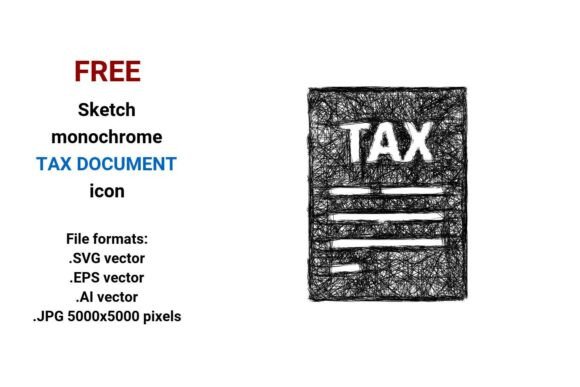
When designing tax-related interfaces, financial dashboards, or accounting educational materials, visual clarity matters—especially when conveying official documentation. The FREE Sketch Tax Document Icon stands out not because it’s flashy, but because it’s intentionally restrained, technically sound, and built for real-world reuse. It’s a monochrome, hand-drawn style icon representing a tax form or document—deliberately sketched rather than polished—making it ideal for contexts where approachability, authenticity, or editorial tone matters more than corporate gloss.
What Makes This Icon Distinct—and Why That Matters
Unlike generic flat icons or overused clipart-style tax symbols, the FREE Sketch Tax Document Icon leans into expressive line art: subtle pencil texture, uneven curves, light tapering strokes, and intentional imperfection. It’s not “rough” by accident—it’s designed to feel human-made, which helps soften otherwise dense topics like tax forms, compliance workflows, or financial reporting. That sketch aesthetic supports storytelling in infographics, onboarding flows, or explainer content aimed at small business owners or first-time filers who may feel intimidated by formal tax language.
This isn’t just stylistic preference—it’s functional alignment. A sketch icon signals informality without sacrificing professionalism, especially when paired with clean typography and thoughtful layout. In practice, users report it performs well in mixed-media presentations: embedded in PDF guides, layered into Figma prototypes, or animated subtly in Lottie-based web components.
Four File Formats—Each With Clear Use Cases
The FREE Sketch Tax Document Icon ships in four widely supported formats—.SVG, .EPS, .AI, and .JPG (5000×5000 px)—each serving distinct production needs:
- .SVG vector: Best for responsive web use—embed directly in HTML, scale infinitely without pixelation, and style via CSS (e.g., stroke color, opacity). Ideal for interactive dashboards or SaaS tax calculators.
- .EPS vector: Industry-standard for print-ready assets. Use when preparing high-resolution brochures, posters, or training manuals where precise ink coverage matters.
- .AI vector: Fully editable in Adobe Illustrator—adjust anchor points, recolor individual paths, or integrate into larger icon systems. Valuable for designers building custom UI kits or brand-aligned finance toolkits.
- .JPG (5000×5000 px): High-res raster fallback. Useful for static social graphics, email headers, or platforms that don’t support SVG uploads—but avoid scaling beyond original dimensions to preserve sketch fidelity.
No format requires licensing fees or attribution—truly free for commercial and personal use. That flexibility lowers friction for freelancers building client websites or educators creating open-access tax literacy resources.
How It Fits Into Real Workflows
Small business owners often need to communicate tax deadlines, filing steps, or deduction categories without sounding bureaucratic. A sketch tax document icon next to a “Q2 Estimated Tax Due” banner feels more conversational than a stiff government seal. Similarly, fintech startups prototyping a new expense-tracking feature might use the icon as a consistent visual anchor across screens—“Upload Receipt,” “Review Tax Form,” “Export Summary”—keeping interface language grounded and accessible.
In academic or nonprofit settings, the FREE Sketch Tax Document Icon supports visual consistency across slide decks, worksheets, and digital handouts. Its monochrome, line-art nature ensures legibility in grayscale printing and screen-reader–friendly contrast when used with appropriate background colors. Educators also appreciate how the hand-drawn quality invites annotation—students can literally sketch notes around the icon during live workshops.
Quality and Technical Reliability
As a vector tax document, this asset holds up under scrutiny. Paths are clean and closed; no stray nodes or overlapping shapes compromise editing. The .AI and .EPS files retain layers and grouping logic, making selective edits efficient. Stroke weights remain consistent across zoom levels—a subtle but critical detail when refining UI spacing or adapting for dark mode.
The .JPG version avoids compression artifacts thanks to its native resolution and lossless export settings. At 5000×5000 px, it supports retina displays and large-format prints while staying under typical CMS upload limits when resized appropriately. Users haven’t reported rendering inconsistencies across browsers or design tools—unlike some crowd-sourced sketch icons that rely on embedded fonts or unsupported filters.
Who Benefits Most—and Where It Falls Short
The FREE Sketch Tax Document Icon serves professionals who prioritize clarity, adaptability, and tone-matching over decorative flair. Freelance UX designers building accounting SaaS interfaces, content marketers producing year-end tax checklists, or nonprofit communicators simplifying IRS form instructions all find immediate utility here.
It’s less suited for contexts requiring strict regulatory symbolism (e.g., official government portals needing standardized seals) or highly branded ecosystems where every icon must match a rigid color palette or stroke-weight system. Because it’s intentionally sketchy and outline-based, it doesn’t include filled variants, shadows, or gradient overlays—so teams needing those variations will need to modify it manually.
Also worth noting: while the icon reads clearly as a “tax document” or “tax form” to English-speaking audiences, its abstraction may require contextual reinforcement (e.g., a label or tooltip) for global or multilingual deployments. It’s a symbol, not a literal illustration—so clarity depends partly on surrounding design choices.
Practical Integration Tips
Start by testing the .SVG version in your primary development environment. If using React or Vue, inline the SVG code to enable dynamic recoloring and accessibility attributes (aria-label="Tax document form"). For print projects, open the .EPS in InDesign and embed—not link—to prevent font or path issues during output.
When adapting the .AI file, duplicate layers before editing. Preserve the original sketch layer as a reference—then build variants (e.g., bolder stroke for mobile, simplified path for tiny favicon use). Avoid converting to outlines unless necessary; keeping text elements live maintains editability if labels are included.
For educators and presenters: pair the icon with minimal supporting text. A single sketch illustration beside “File Your 1099-NEC” conveys action faster than a paragraph. In slide decks, use the .JPG at 25% scale—still sharp, but lightweight for fast loading.
A Thoughtful Tool, Not a One-Size-Fits-All Solution
The FREE Sketch Tax Document Icon succeeds because it understands its role: not to dominate attention, but to clarify intent. It’s neither overly technical nor cartoonish—striking a balance many finance-related assets miss. Its strength lies in restraint, consistency across formats, and respect for the user’s context—whether that’s a solo freelancer updating a WordPress plugin page or a university department publishing open tax curriculum.
If your work involves communicating about accounting, tax forms, or financial documentation—and you value assets that are editable, scalable, and tonally appropriate—the FREE Sketch Tax Document Icon is worth evaluating alongside your existing toolkit. It won’t solve complex design problems alone, but as a reliable, human-centered vector tax document button or infographic sketch icon, it removes friction without demanding compromise.