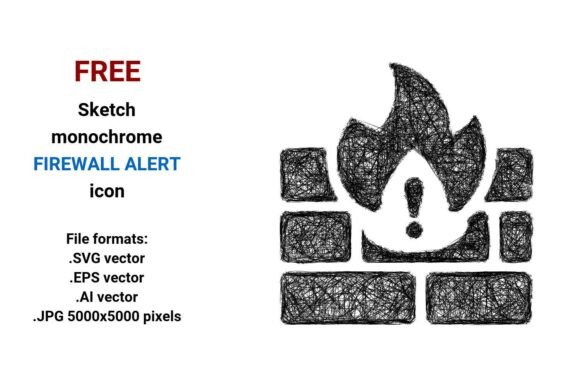
FREE Sketch Firewall Alert Icon: Scalable, Artistic Security Visuals for Modern Digital Projects
Firewall alert icons are more than decorative elements—they’re functional signifiers that communicate urgency, protection, and system integrity at a glance. Among the most versatile options available today is the FREE Sketch Firewall Alert Icon, offered in four production-ready file formats: .SVG vector, .EPS vector, .AI vector, and .JPG (5000×5000 pixels). Unlike pixel-based graphics, this collection leverages the mathematical precision of vector imagery—meaning it scales flawlessly from a 16-pixel favicon to a 4-meter trade show banner without blurring, distortion, or quality loss. Its hand-drawn, minimal line sketch aesthetic bridges technical clarity with human-centered design—a rare balance in network security visualization.
Why Vector Architecture Matters for Network Firewall Icons
A vector image is fundamentally different from raster graphics. Instead of fixed grids of colored pixels, it uses geometric formulas to define points, paths, curves, and fills. This architecture makes every firewall alert icon in this set inherently scalable, editable, and resolution-independent. Designers can adjust stroke weight, recolor individual layers, or isolate the shield-and-exclamation motif for custom animations—all without degradation. For developers integrating into UI kits or documentation, the .SVG format supports CSS styling and JavaScript interactivity; for print teams, the .EPS and .AI files embed cleanly into Adobe Creative Suite workflows. Even the high-res .JPG serves as a reliable fallback for legacy CMS platforms or email clients that don’t render SVG natively.
This technical foundation directly supports real-world use cases. A cybersecurity educator building an open-access course on network firewall fundamentals can embed the same icon across slides, handouts, and interactive quizzes—knowing consistency and legibility hold at every size. An e-commerce platform selling endpoint protection software might animate the sketch-style firewall alert button on its product page, then reuse its clean silhouette in app store badges and social media thumbnails. No reworking. No asset fragmentation. Just one source, infinite applications.
The Design Language: Minimal Line Sketch Meets Technical Clarity
The FREE Sketch Firewall Alert Icon embraces a deliberate sketchy, hand-drawn sensibility—not as a stylistic gimmick, but as a cognitive tool. Research in UX shows that lightly imperfect, freehand line work increases perceived approachability and reduces user anxiety around complex topics like security and network infrastructure. Yet it never sacrifices recognition. The icon retains universal pictogram conventions: a simplified shield (representing defense), an exclamation mark (signaling alert status), and subtle network-like connecting arcs—evoking network firewall topology without visual clutter.
This minimal line sketch approach also enhances accessibility. High-contrast black-and-white rendering ensures readability for users with color vision deficiencies, while the generous negative space and uncluttered contours improve screen reader parsing when paired with appropriate aria-label attributes. Unlike photorealistic or heavily shaded alternatives, this artistic sketch icon avoids visual noise that competes with surrounding interface elements—making it ideal for dense dashboards, incident response consoles, or embedded IoT device displays where information hierarchy is critical.
Practical Applications Across Roles and Industries
Different professionals interact with firewall alert icons for distinct purposes—and this set accommodates them all without compromise.
- Software developers integrate the .SVG version directly into React or Vue components, applying dynamic classes to indicate severity levels (e.g., stroke color shifts from amber to red on critical events). The editable nature of the .AI file allows engineering teams to align icon proportions precisely with their design system’s spacing tokens.
- Educators and researchers use the .EPS export to insert crisp diagrams into academic papers or conference presentations about network security frameworks. Its vector fidelity ensures journal publishers won’t downgrade resolution during PDF compression.
- Product designers leverage the sketch style to maintain visual continuity across onboarding flows—pairing the firewall alert button with similarly rendered toggles, sliders, and status indicators. The scribble-inspired linework subtly reinforces concepts of monitoring and responsiveness.
- Small business owners deploying DIY security tools benefit from the .JPG variant for quick uploads to WordPress security plugins or shared Google Slides decks used in team training. Its 5000×5000 pixel resolution provides ample headroom for cropping, zooming, or adding branded overlays later.
- Hobbyists and open-source contributors remix the editable sketch icon using Inkscape or Figma—extending it into animated loading states, dark-mode variants, or multilingual tooltip versions—thanks to fully layered, non-destructive vector construction.
Workflow Integration: From Concept to Deployment
Adopting the FREE Sketch Firewall Alert Icon fits seamlessly into modern design and development pipelines. Here’s how it works in practice:
- Discovery & Selection: A UX writer drafts microcopy for a new intrusion detection dashboard. They search “firewall alert icon” and filter for “black and white”, “vector”, and “free”—landing on this set due to its semantic naming, transparent licensing, and immediate format availability.
- Customization: Using the .AI file in Adobe Illustrator, they adjust the stroke width to match their type scale (1.25px for body text, 2px for headings) and export a custom .SVG with optimized path data and inline titles for SEO-friendly alt text.
- Implementation: A front-end developer imports the SVG as a React component, adding conditional props:
isCritical={true}triggers a pulsing animation via CSS keyframes, whileisAcknowledged={false}applies a subtle border glow. No external dependencies—just native browser capabilities. - Documentation & Handoff: The same SVG file is embedded in internal Confluence docs with descriptive captions like “Sketch firewall alert icon — indicates active threat detection in network firewall layer”, reinforcing context for future maintainers.
This end-to-end flow eliminates version drift, reduces asset management overhead, and maintains design-system coherence—all because the underlying vector firewall alert button was built for adaptability, not just aesthetics.
Strategic Considerations When Choosing Firewall Alert Visuals
Not all firewall alert icons serve the same purpose—or audience. Before selecting any asset, consider these practical factors:
- Contextual contrast: Will the icon appear over gradients, photos, or dynamic backgrounds? The black and white nature of this set guarantees legibility across diverse UI contexts—unlike colored icons that may require manual background masking.
- Licensing transparency: This FREE Sketch Firewall Alert Icon carries clear attribution-free usage rights for commercial and personal projects—a critical advantage over stock libraries requiring ongoing subscriptions or restrictive attribution clauses.
- Future-proof scalability: As interfaces evolve toward foldables, AR overlays, and voice-assisted dashboards, vector assets remain relevant. Raster-only sets risk obsolescence as pixel density requirements escalate.
- Cognitive load: Overly detailed icons (e.g., 3D-rendered firewalls with cables and servers) compete with primary content. This clean, line icon delivers maximum signal-to-noise ratio—communicating alert and firewall in under 0.5 seconds of visual processing time.
Importantly, the sketch firewall alert doesn’t sacrifice professionalism for simplicity. Its intentional imperfections signal human oversight—a vital reassurance in automated security environments where users need to trust both the system and the people behind it.
Extending Value Beyond the Icon Itself
The utility of this FREE Sketch Firewall Alert Icon extends beyond its immediate visual function. Because it’s delivered in industry-standard vector formats, it becomes a springboard for broader design system development:
Designers can extract its core curve language to inform button radii, card corners, or data visualization paths. Developers can convert its stroke definitions into CSS custom properties for consistent theming. Educators can deconstruct its composition in classroom exercises on visual semiotics—asking students how line weight, spacing, and abstraction influence perception of security and urgency. Even researchers studying digital literacy can use its consistent rendering across devices as a controlled variable in eye-tracking studies on network interface comprehension.
In essence, this isn’t just a download—it’s a foundational element for building trustworthy, scalable, and inclusive digital experiences around firewall, network, and security concepts. Whether you're prototyping a next-gen SOC interface, illustrating a university lecture on zero-trust architecture, or simply adding clarity to a small business’s Wi-Fi settings page, the scalable sketch icon delivers precision without pretense—and does so entirely free of cost or complexity.